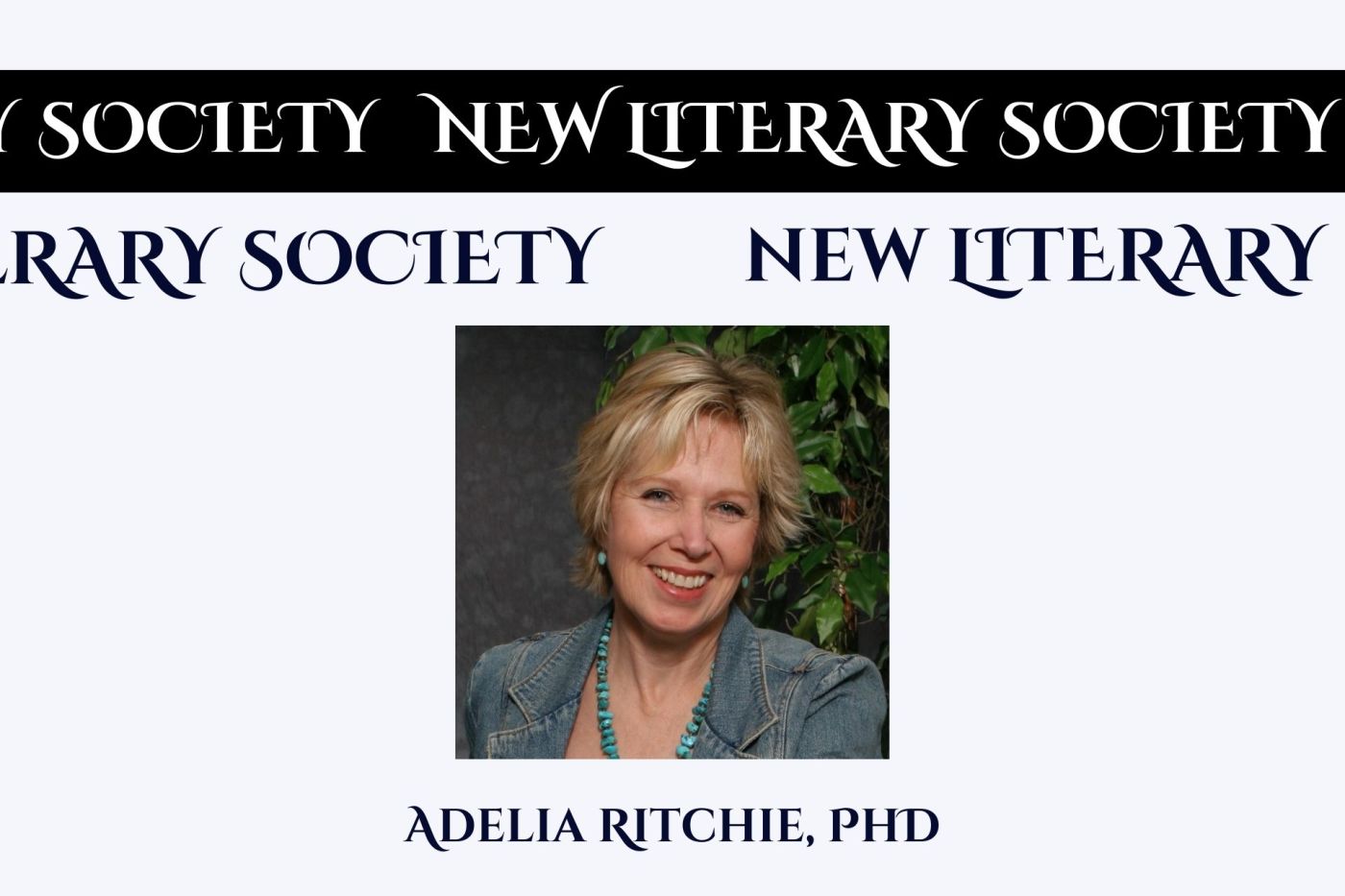
Meet Adelia Ritchie, PhD, Author of The Accidental Expat: A Costa Rican Adventure
Original Publication Details: First published by julia kalman in the NEW LITERARY SOCIETY, on May 1, 2024, in English.
One of life’s sharp turns leads author Adelia Ritchie to make a new home in Costa Rica, a country she’d only visited in prior years.
Adelia Ritchie has found the Pura Vida many of us seek.
Read, and enjoy the ride!
1. That Special Moment
One fine day, you started writing. How did it happen exactly?
AR: I was on a short business trip to Lithuania in April 2010.
A friend had challenged a group of us to write a poem every day for the entire month, it being National Poetry Month!
I accepted, thinking I could write poetry on the plane, and one or two poems while in the country.
But it turned out that the Icelandic volcano eruption shut down air traffic and stranded me in Vilnius for five weeks, during which I explored the city, took lots of photos, and wrote a poem every day of the month.
I eventually published them in my first chapbook, “Leaves of Glass.”
2. Art Is Work
What does your work as a writer consist of? What are the biggest challenges of the present?
AR: There are several parts to my life as a writer.
One part is writing for pleasure and because I have something I need to say.
This part cranks out poems and essays, mostly published on Medium.com and Substack.com.
Another part is technical writing, which helps pay the electric bill. I write proposals, corporate policy documents, internal work instructions, technical proposals, and the like.
And the other part, the most fun of all, is writing memoirs and adventure stories, like in my recent book “The Accidental Expat: A Costa Rican Adventure.”
The biggest challenge right now is finding enough time to write for myself, i.e., to finish that memoir about adventures with my dad, and then finish my second “Expat” book of adventures in Costa Rica!
3. Without Projects, There Is No Future
What are your representative projects? What projects are you working on?
AR: My father was a very interesting and unusual man, not bound by anyone’s book of rules other than his own.
The project I’ve been working on in between finishing my current new book and working as a technical writer is a memoir about me and my dad, his crazy life, and our adventures together, from Japan to northern Virginia to Paris to Frankfurt and many other adventures in between.
Sometimes I believe I am a female clone version of him, and the more I write, the more I believe it.
I’m also compiling a manuscript of poems I’ve written over the years.
My poems are often light and humorous, with a story to tell, and I hope to get this work into publication by the end of this year.
4. The Scent of Creation
Describe a scent that immediately transports you to a moment of inspiration or creativity. What emotions does it evoke, and how does it influence your creative process?
AR: The scent of a Pacific Ocean wave lapping against a Central American beach transports me.
It takes me away from daily pressures and lands me squarely in the present moment, and when I’m lucky enough to have my painting kit with me, I often just sit down in the sand and start sketching in watercolors.
The rest of the world doesn’t exist in those moments.
5. Ink and Intimacy
If your writing style were a tactile experience, what texture would it be? How does the act of putting pen to paper or fingers to keyboard make you feel on a deeply personal level?
How does the act of putting the pen on paper or fingers on the keyboard make you feel, at a deeply personal level?
AR: My Muse is “the little man in my head who gives me a report each morning.”
When I’m thinking about a project, I will give my “little man” the assignment so that I don’t have to be conscious of it while I’m working on something else.
The next day or so, when I sit down at my computer to write about the project, I’m not consciously aware of exactly what I’m going to say… that is until my fingers hit the keyboard and the words flow out as if someone else were dictating them to me.
My “Little Man” is my unconscious, and over the years I have learned how to make him do much of the heavy lifting, often while I’m sleeping.
Writing like this is a joy beyond description.
6. The Harmony of Silence
Think about a moment when silence spoke louder than words in your creative journey. What were the circumstances, and how did it shape your understanding of your craft?
N/A
7. The Palette of Dreams
Imagine your creative mind as a painter’s palette. What colors dominate your artistic spectrum, and how do they represent the different facets of your imagination?
AR: My entire life has been intensely colorful, on many levels.
As an artist, my palette is filled with strong colors, primaries, and brights.
Life is meant to be lived surrounded by happy colors and filled with laughter… and never a “dull” moment.
8. The Quill of Vulnerability
If your creative expression were a handwritten letter to your inner self, what truths and vulnerabilities would it unveil? How does the act of exposing your innermost thoughts contribute to your artistic identity?
AR: When I was 16 years old, I wrote a letter to myself that began with “Dear Sad Girl…”
Somehow, I managed to keep that letter all these years and I reread it now and then, with a smile, remembering the lessons I was teaching myself about all the mistakes a young person makes and that it’s all going to be okay someday.
These days I have learned that honesty in writing is key and that readers wish to connect, to relate to the writer’s vulnerabilities and mistakes.
And I have reached that magical age where I no longer worry too much about what people will think about my opinions, advice, experiences, or biases, and I just tell it as I see it.
My readers tell me that, when they read my essays, it’s as if I’m talking directly to them.
They are connecting directly with me. And that’s exactly what I hope for.
9. Symphony of Shadows
Consider a character or theme in your work that embodies the shadows of your own psyche. What does this shadow teach you about your fears, desires, or unexplored dimensions of your creativity?
Is that the case?
AR: I do not write fiction, so the characters in my stories are real. I don’t look for shadows and fears in my writings, but more for the humor and silliness of everyday life experiences.
Occasionally I will write a poem that evokes heartache or searching for something or someone.
Once at a poetry workshop, I read some fun villanelles that evoked a few chuckles from the audience.
But later that day, a well-known poet (male) took me aside to tell me, “I never write funny poems.”
What he was trying to tell me in his arrogance was that poetry isn’t poetry unless it’s filled with angst and depression.
No, that’s not at all who I am or what I write.

10. Echoes of Childhood Whispers
Recall a childhood memory that resonates with you as a writer. How do the echoes of your early experiences manifest in your work today?
AR: When I was a little girl on a huge farm in northern Virginia, USA, I had an adorable pet pig that I had caught in a greased-pig-catching contest at the county fair.
My dad let me keep her and she became the family’s best friend and comic entertainment.
Some of my earliest memories of my dad and his irrepressible humor are from those days with Porky and our pack of hunting dogs, which she led on hunts.
And decades later, my dad’s last great belly laugh, with tears rolling down, was when he recalled the story of that day when Porky tried to point at a pheasant in the brush.
Her curly tail refused to straighten.
The entire group of hunters were laughing so hard that they all had to retreat to the farmhouse for a shot of whiskey.
These are the kinds of stories that I love to write.
11. Melodies of Memory
If your memories were composed as a musical score, what instrument would represent your most cherished creative recollections?
How does the melody of your past influence the composition of your present work?
AR: My first thought is “Flight of the Bumblebee” played on a flute! I have had so many experiences in so many places, having moved households 59 times since I was born, around the world, tasting cultures, sipping native liqueurs, and learning a few words of many languages.
I have seen and learned and felt ten lifetimes of things most people can barely relate to, and I think all those life experiences enable connections and novel ideas that wouldn’t be possible if, for example, I had lived in a small town my entire life.
A girl needs to flap her wings and buzz off, or she’ll grow old and boring.
12. The Dance of Syntax
If your writing style were a dance, what would be the rhythm and tempo? How does the cadence of your sentences mirror the beating of your creative heart?
N/A
13. Admiration Exercises
Which writers do you admire? What are your favorite books?
AR: One of the most profound and impactful was “Ecology of Commerce” by Paul Hawken.
With the global economy based on growth, including that of population, the sustainability of business and manufacturing processes is a crucial concern.
I have used the principles outlined in this book dozens of times in business, in politics, and life.
“Sapiens,” by Yuval Noah Harari, left me gobsmacked and slack-jawed with its god’s-eye-view of the history of the world, including the evolution of mankind, condensed into one un-put-downable tome that defines what it means to be “human.”
Another, entitled “1491,” by Charles C. Mann, portrays the deep history of the pre-Colombian Americas, a story that has little to do with what I was taught in history classes as a youth.
Now, as a resident of a tiny Central American country, I have a completely altered perspective on colonialism and the devastation it brought to the indigenous peoples and their civilizations.
14. An Indiscreet Question
With which influential author or inspirational figure from life, past or present, would you most like to share a cup of tea and a captivating conversation?
AR: Definitely, Sir David Attenborough, a fascinating and engaging storyteller.
He is an English broadcaster, writer, and naturalist noted for his innovative educational television programs, especially the nine-part Life series.
His broadcasts and writings have been a significant part of my interest for decades.
What I love about this man is his curiosity and his motivation to share his vast knowledge about nature and the sometimes-invisible connections that tie all things together, both living and inorganic.
15. A Story in Ten Words
Drought and dust. Downpours and flooding. Climate change has arrived.
16. A Favorite Fragment from Your Works
AR: I enjoy writing 75-word novels, tiny stories that have a character, a situation or drama, and a resolution. Here’s one example, entitled “Late Night Cuppa”:
In over 20 years of serving burnt coffee to late-night drunks, she had never felt such a body slam to her amygdala, having felt only numbness for too long.
His musky scent invaded her nostrils and lungs, metastasizing through her like earthworms sliding through rich damp soil.
His look told her everything she needed to know.
Her steady hand moved toward him.
Heaving a sigh, she poured him another cup.
17. Contact Information
How can you be contacted?
AR: By email at adeliar@gmail.com.
18. Blog/Author Page/Social Media Profile
Where can we read your works?
AR: I have two publications running on Substack, “Tico Tales” and “Adelia’s Substack.”
Access here: https://aritchie.substack.com
19. What exactly would you like to convey to a fellow writer/editor/screenwriter/film producer?
AR: Honesty, passion, vulnerability, entertainment, education, and connection are my primary values when writing.
I believe readers possess finely tuned BS detectors, which I never want to set off!
And I believe readers more deeply engage with writers who are passionate about what they are saying.
Readers also want to connect with someone whose defenses are down, who is fear-lessly exposing their inner selves to the world.
I also love to entertain, and many of my pieces are humorous, sometimes in a subtle way, sometimes not.
There is so much happening in our world these days that is difficult to understand and easy to ignore because of a lack of knowledge.
For these reasons, many of my essays deal with science that the reader can directly relate to and that affects them daily.
My stories are real and true and full of heart and life.
And most of them are delicious fun!
Where can your works be read (in English)?
AR: In addition to Substack, which is free for everyone at this time, my newest book, “The Accidental Expat,” can be found on amazon.com (https://a.co/d/18Zqil6) in both paperback and eBook versions.
For the Romanian reader, the book is available on Libris:
https://www.libris.ro/the-accidental-expat-a-costa-rican-adventure-BRT9798890610683–p37080246.html
20. Embers of Endings
Envision the conclusion of a significant project. How do you feel as you pen the final words or brush the last strokes? What is the emotional resonance of completion, and how does it influence your anticipation for the next artistic endeavor?
AR: When I complete that final edit before I send off a manuscript, I feel as if I have just run out of gas, that I’ve been zooming ahead at full speed, and then dead stop.
That’s when it’s time for a glass of wine and a nap, and later get up and read the entire thing one more time!
A manuscript is never finished.
There will always be improvements that could be made, but one must ultimately just stop and let it go.
That decision brings tremendous relief and excitement.
And finishing one essay, memoir, or poem brings on a flood of new energy (after a nap) to jump-start the next project.
One of life’s sharp turns leads author Adelia Ritchie to make a new home in Costa Rica, a country she’d only visited in prior years.
In this book, she shares her learning curve with us in sometimes hilarious, but always direct, conversation.
Like a favorite neighbor or BFF, she describes the challenges and rewards of starting anew - whether mastering difficult terrain (must have 4WD, and Courage) or making important discoveries (howler monkeys are always loud and have an odd sense of humor - bring a hard hat on nature walks!).
Through it all, her fresh eyes find the Ticos charming and their way of life compelling, and her artworks reflect the unbridled beauty of her surroundings.
Adelia Ritchie has found the Pura Vida many of us seek.
Read, and enjoy the ride.


 Julia Kalman
You must be logged in to post a comment.