
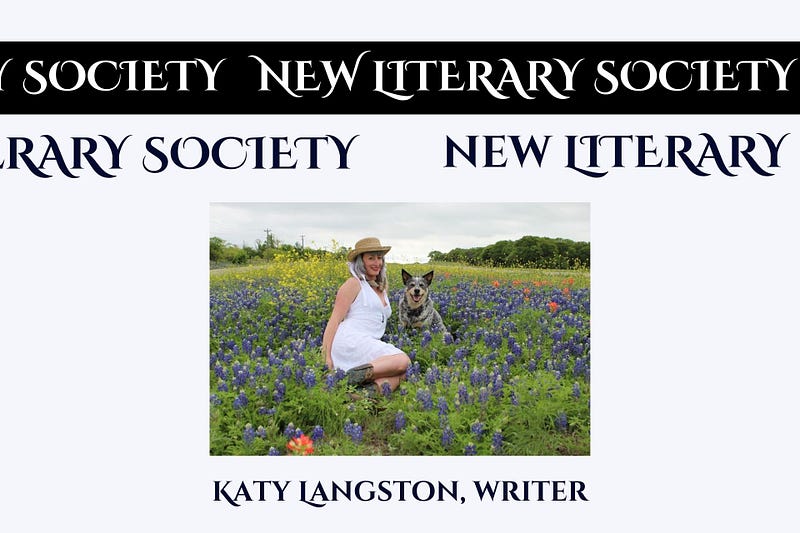
Discover the Evolution of a Writer from Darkness to Brilliance
Greetings, dear writers!
Prepare to be surprised by Katy Langston’s transformation! From the depths of shadows to the light, follow Katy Langston’s journey as she conquers herself, harnesses energy, and emerges as a model of inspiration.
I found myself there and so will you… maybe in her childhood memories, her adolescent dramas, or her addictions.
We all have a lot to learn from her story.
As for me… I think I’ll dedicate her, my next book.
Thank you, Katy Langston, for being you!!!
[Julia Kalman]
https://seenandgreen.com/category/health/
Motto (1): “I never saw a wild thing sorry for itself. A small bird will drop frozen dead from a bough without ever having felt sorry for itself.” ― D.H. Lawrence
Motto (2): “When the going gets tough, the tough get going.” — Garfield… The cat.
1. That Special Moment
One fine day, you started writing. How did it happen exactly?
KL: I suffered life-threatening withdrawals when I quit drinking alcohol over three years ago which was horrific, but also enlightening.
After being sober for a few months, I experienced a surge in creativity and cognitive regeneration.
On top of that, with the numbing agent gone, my old traumas were bubbling to the surface, and I needed an outlet.
My therapist kind of sucked, so I fired her.
Then I found my life coach, Heidi Rain.
She helped me crack the code to my past experiences, my current relationships, and myself through thought-provoking journal prompts.
I was writing so extensively in her class and felt a little embarrassed about it!
But she said it was essential for healing, and she was right.
She told me, “You should write a book,” so I figured I’d start with blogging and writing on Medium.
Since I started writing, I can’t stop!
2. Art Is Work
What does your work as a writer consist of? What are the biggest challenges of the present?
KL: Being a lifestyle blogger and Medium writer, I’ve committed to consistency — posting twice a week on my personal website, Seen and Green, and posting at least once a week on Medium.
I refuse to choose a niche, so my lifestyle blog offers a wide range of topics: health, wellness, codependency, art, eco-friendly living, beauty, fashion, recipes, and more. My blog caters to Google’s search engine optimization, so my posts have a chance to rank when certain keywords are searched.
Medium, on the other hand, is where I post the juicy stuff. I get very personal on Medium.
I never suffer from writer’s block.
My biggest challenge is finding time to write about all of my ideas, especially lately.
I’m moving to Alaska in June and have to take a bunch of tests upon arrival to renew and upgrade my licensing in the water and wastewater industry.
In addition, I’m studying for my hazmat and tanker endorsements to add to my commercial driver’s license.
Writing consistently has been difficult during this time, so I’ve been posting simple things on my blog, like “Bug Photography” for example.
3. Without Projects, There Is No Future
What are your representative projects? What projects are you working on?
KL: I’ve recently pulled all of my horror fiction shorts from Medium, because it’s just not the right platform for that genre.
When I get the time, I plan to compile the stories into a horror anthology for traditional publication submission through a literary agent.
On top of that, I’ve started a novel, but it’s still in the womb.
4. The Scent of Creation
Describe a scent that immediately transports you to a moment of inspiration or creativity. What emotions does it evoke, and how does it influence your creative process?
KL: I have a nose like a bloodhound and an idea factory for a brain, so literally any smell could influence my creative process!
5. Ink and Intimacy
If your writing style were a tactile experience, what texture would it be? How does the act of putting pen to paper or fingers to keyboard make you feel on a deeply personal level?
KL: I refuse to choose a niche, so my writing ranges from razor sharp to… soft as satin sheets.
When I was working with my life coach, she said: “Recovering addicts and alcoholics don’t just need a job.
They don’t just need to be productive members of society.
Everyone needs a purpose. YOU need a purpose.”
Writing is my purpose.
Putting my fingers on the keyboard makes me feel justified, validated, and healed.
For the first time in my life, I’m telling my stories to an audience that is actively listening and providing positive feedback.
As a kid, I endured years of emotional and psychological abuse from my junkie parents and was then unwillingly crowned the family scapegoat.
My parents were eager to throw me under the bus to take the attention off their drug problems, and my grandparents, aunts, and uncles — who had been kind to me in early childhood — played along so they wouldn’t have to admit their role in the overall dysfunction of the family.
I was sacrificed to protect the collective psychological safety of the group.
Tossed out.
Discarded.
Unimportant to everyone — except for myself.
At 16 years old, I moved out, started working, stayed in school, and graduated with perfect attendance and AB Honor Roll, all while paying to live with roommates in super sketchy parts of town.
I remember walking 3 miles from school to work, working until 11 pm, and then walking “home” from work through crime-ridden neighborhoods, dressed like a guy, with my head down, so I wouldn’t draw unwanted attention.
In the morning, I’d wake up at 7 am and do it all over again.
At school I was harassed daily, being called “ugly” and “dyke” when I stopped wearing makeup and tight clothes.
The little assholes didn’t realize that my lack of fashion sense was a deliberate survival technique.
Being seen as ugly kept me safe on the streets.
When I started writing about my trauma, I thought it was just for me, but I’ve received an overflow of comments from people saying that I’ve helped them process their own past, and I can’t describe how good that feels.
Something about sharing our most significant life experiences helps others.
Scapegoats are common among dysfunctional families, and we carry a unique type of pain that is very isolating. Sharing our experiences helps craft a community of healing, hope, and solidarity.
https://seenandgreen.com/category/health/
6. The Harmony of Silence
Think about a moment when silence spoke louder than words in your creative journey. What were the circumstances, and how did it shape your understanding of your craft?
KL: Ironically, I have nothing to say about this…
Maybe this is my silent moment? (For once! Ha!)
7. The Palette of Dreams
Imagine your creative mind as a painter’s palette. What colors dominate your artistic spectrum, and how do they represent the different facets of your imagination?
KL: Deep blue.
The ocean of dreams.
Calming and nurturing, yet ferocious, unpredictable, and wild.
8. The Quill of Vulnerability
If your creative expression were a handwritten letter to your inner self, what truths and vulnerabilities would it unveil? How does the act of exposing your innermost thoughts contribute to your artistic identity?
KL: As I mentioned before, I lost myself to alcoholism for 4 years.
Drinking became a part of my identity, and I wasn’t proud of that.
It all comes down to habits.
You are what you do.
The practice of writing helps build identity in a self-feeding loop.
By reliving past experiences in written form, I understand myself better.
I’m basically conducting science experiments when I examine my experiences from every angle possible.
I’m taking notes and discovering new information buried within old memories, and every time that happens it feels like leveling up.
Like I’m a Pokémon that’s evolving or something.
Habits + Time = Identity.
9. Symphony of Shadows
Consider a character or theme in your work that embodies the shadows of your own psyche. What does this shadow teach you about your fears, desires, or unexplored dimensions of your creativity?
Is that the case?
KL: I’ve gone to great lengths to explore every cavern in my mind. All of my shadows have been illuminated. I’ve never felt so Zen.

10. Echoes of Childhood Whispers
Recall a childhood memory that resonates with you as a writer. How do the echoes of your early experiences manifest in your work today?
KL: As I mentioned above, my teen years were hell, but my early childhood was fantastic.
My family used to take trips to the ocean.
We’d book a nice condo right on the beach and just absorb nature for a whole week.
I was obsessed with the ocean and wanted some alone time with it, so I snuck away from the group when they were playing tennis.
Instant relief washed over me as I collapsed onto the dune.
The wind combed through my dirty blonde hair, and I began to sing a spontaneously invented amalgam of expressions and melodies.
It was a spiritual moment.
I felt so connected to the Earth — until my sister found me.
Of course, I was scolded for “running off like that.”
“You could have been kidnapped!” my aunt had said.
No one in my family ever understood my introversion and creative notions.
Now that I’m an adult, I’m able to communicate my need for alone time.
Solitude is necessary for tapping into my creative side.
11. Melodies of Memory
If your memories were composed as a musical score, what instrument would represent your most cherished creative recollections? How does the melody of your past influence the composition of your present work?
KL: The instruments of Earth and all its creatures.
Bird and frog songs, waves on a shoreline, wind through the trees, thunder, and rain.
Nature is my center.
Nothing makes me feel more alive, calm, and connected.
12. The Dance of Syntax
If your writing style were a dance, what would be the rhythm and tempo? How does the cadence of your sentences mirror the beating of your creative heart?
KL: I’ve seen some really cool interpretive dances that tell a story.
My Medium writing style is always in the form of a story.
As far as the heart goes…
It’s adaptable.
It will pound heavily when exerted through physical or emotional prompts, and it will thump methodically during times of peace.
My writing is the same.
13. Admiration Exercises
Which writers do you admire? What are your favorite books?
KL: Clive Barker is my favorite author.
I love his book Weaveworld and his horror anthology, Books of Blood.
For some reason, horror fiction calms me, and I need it in my life.
14. An Indiscreet Question
With which influential author or inspirational figure from life, past or present, would you most like to share a cup of tea and a captivating conversation?
KL: Actress and stuntwoman, Zoe Bell.
She did stunts for Uma Thurman in Kill Bill, has starred in some Quinten Tarantino movies like Death Proof, and she was the main star in the fight movie, Raze.
Zoe is a badass and I’d love to tell her how much I love her work.


15. A Story in Ten Words
I’ve never been to Alaska, but I’m moving there soon!
16. A Favorite Fragment from Your Works
My muscles tear and repair
My heart is no different
For the love of perspiration
Respiration and aspiration
I keep moving
The Earth is no different
For the love of being alive
The galaxies stretch far and wide
From “A Fighter’s Philosophy” on Medium
17. Contact Information
How can you be contacted?
KL: Via my blog, Seen and Green or my Medium account, Katy Langston https://medium.com/@katyannlangston
18. Blog/Author Page/Social Media Profile
Where can we read your works?
KL: “No-food coloring purple fudge?” No way! (Yes way.)
Via my blog, Seen and Green or my Medium account, Katy Langston https://medium.com/@katyannlangston
19. What exactly would you like to convey to a fellow writer/editor/screenwriter/film producer?
KL: Write because you love to and be consistent. Be patient, and your work will eventually gain traction and visibility.
Where can your works be read (in English)?
KL: Via my blog, Seen and Green or my Medium account, Katy Langston https://medium.com/@katyannlangston
Present your writings in a few words.
KL: My writing covers a wide range of topics: sobriety, addiction, codependency, emotional trauma, health, fitness, nutrition, environment, sustainability, DIY/Natural beauty, art, horror fiction, humor, and more.
20. Embers of Endings
Envision the conclusion of a significant project. How do you feel as you pen the final words or brush the last strokes? What is the emotional resonance of completion, and how does it influence your anticipation for the next artistic endeavor?
KL: It varies with the content.
When I finished writing “Dear Vice, Thanks for Ruining my Marriage,” I was trembling, basically reliving the trauma.
When I finish writing horror fiction I laugh maniacally.
It isn’t weird…
When I finish writing about eco-friendly products, I feel content.
Upon completion of this interview, I feel grateful for being seen!
Thank you so much!
https://seenandgreen.com/category/health/
Introducing the New Literary Society Publication
The New Literary Society is dedicated to promoting writers and their work.
Each week, we aim to publish an interview, along with the possibility of translating (into Romanian and/or German) and sharing it beyond Medium, on WordPress.
How to Apply
If interested in doing the interview, simply write to —
• newliterarysociety@protonmail.com (Julia)
• NLS.Submission@gmail.com (Sal)


 Julia Kalman