
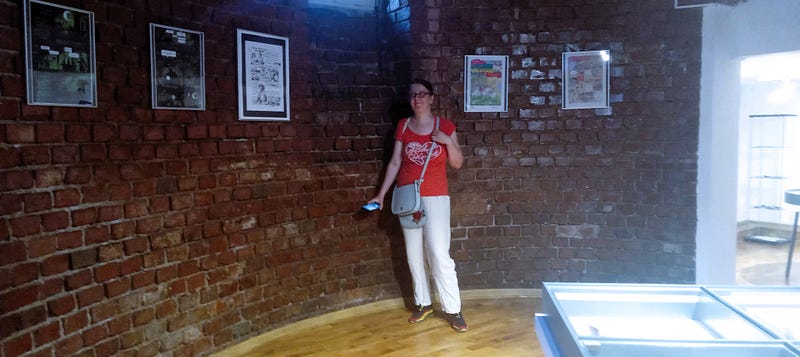
Photo by Julia Kalman.
Unveiling the Enigmatic World of Anca Hirschpek: From Childhood Inspirations to Present Creations
🐣🌷🐰 Happy Easter! 🌸🐇🥚 💙 Dear Friends, please take a moment to engage with my story, dedicating at least 30 seconds to reading it. I deeply value the genuine interaction of readers like you. Thank you sincerely. 💙
1. That Special Moment
One fine day, you started writing stories. How did it happen exactly?
AH: It was a long time ago, yet I recall the setting vividly.
I was eight years old, alone in my room, it was summer, I was relaxing, and then, like an electric spark, I felt compelled to write a lyric about a mountain panorama.
I hastily grabbed a pencil and a piece of paper; my ideas were too quick for my writing pace…
For years, I preserved the crumpled sheet of paper as a unique jewel, along with a “creative notebook” with blue covers, which I still have…
2. Art Is Work
What does your work as a writer consist of? What are the biggest challenges of the present?
AH: It would be lovely if it was work, but it isn’t, and I don’t have the energy or peace I need.
With three children and full-time work, it’s tough for me to find a location where I can allow myself to be inspired.
Rather, I attempt to take notes as they arrive, and when I have some free time in front of a computer, I assemble them, sift through the false additions, chisel…
3. Without Projects, There Is No Future
What projects are you working on?
AH: A new anthology of short fiction, essays, and notes.
There is ample material for it.
Additionally, I will review and edit another collection of poetry for similar purposes.
3. The Scent of Creation
Describe a scent that immediately transports you to a moment of inspiration or creativity. What emotions does it evoke, and how does it influence your creative process?
AH: Usually, there are a few fragrances from long ago — one of oranges, cinnamon, baked apples — that remind me of holidays and folks who once protected me but are now just shadows in the corners of my memory.
There would also be the smell of roses — true domes stood in front of the block of flats where I spent my childhood in the Colentina neighborhood. When it rained, the ambiance was heady.
Similarly, the aroma of the barn, straw, and grass brings me to the countryside, Rădășeni, situated in Moldavia, and the fairy-tale locations of my childhood holidays.
And others are difficult to decipher — smells of encounters, protection, and seduction — that I occasionally stumble across purely by chance and which, certainly, transport me to a parallel realm wanted, awaited, but more unreal than the shadow of a cloud at sunset…
4. Ink and Intimacy
If your writing style were a tactile experience, what texture would it be? How does the act of putting pen to paper or fingers to keyboard make you feel on a deeply personal level?
AH: I’m still a slave to pencils and pens.
I have numerous notebooks and agendas at work, in my backpack, and at home so that I may scribble down thoughts that come to mind at any moment.
So, I need to feel, touch, grab, turn the paper, and doodle all kinds of things.
The keyboard does not provide these indulgences, and its rhythmic noise can be distracting at times, despite appearing to be more efficient.
5. The Harmony of Silence
Think about a moment when silence spoke louder than words in your creative journey. What were the circumstances, and how did it shape your understanding of your craft?
AH: Every time I fall in love, something happens: the emotional overflow is valuable enough for me.
Despite feeling prompted to write, I frequently keep my thoughts to myself for a while.
Discretion is an unchanging treasure.
6. The Palette of Dreams:
Imagine your creative mind as a painter’s palette. What colors dominate your artistic spectrum, and how do they represent the different facets of your imagination?
AH: The solar hues of pink, orange, and purple, associated with morning, as well as the bright golden yellow of noon, set against azure skies, offer me unexpected hope…
8. The Quill of Vulnerability
If your creative expression were a handwritten letter to your inner self, what truths and vulnerabilities would it unveil? How does the act of exposing your innermost thoughts contribute to your artistic identity?
AH: Yes, I occasionally get the sensation that not many people understand what I’m saying.
People who are patient enough to read have told me that I am not addressing the broad public, but rather a more elitist portion capable of deciphering the amalgam of meanings and pictures that can give the sense of chaos, of a vortex.
At the same time, I recognize that I do not communicate my most intimate ideas…
Some people have admitted to me that they have printed my texts and have studied them regularly to decipher additional meanings.
I’m sometimes interested in how certain people can transfer themselves into my worlds, into Alter-Egos that can be so fragile at times, and feel at ease there, resonating with the senses of new universes…
9. Symphony of Shadows
Consider a character or theme in your work that embodies the shadows of your own psyche. What does this shadow teach you about your fears, desires, or unexplored dimensions of your creativity? Is that the case?
AH: Certainly, the themes of obsession, jealousy, and envy — feelings that occasionally escalate within me, possibly due to a personality or temperamental shift paired with great fatigue.
I sometimes gather a lot of frustrations and am unable to recognize or reveal them, even when I feel like I’m about to burst.
I need something or someone to believe in, who can show me the significance, and who can divert my attention; otherwise, I will continue to agitate myself among the various — often fake — traumas.
What have you learned from writing about these fears, desires, or vibrations?
Almost nothing; writing about your emotions does not always resolve them; in fact, they can worsen.
It depends on the state.
It’s worth writing when you’re completely honest, don’t wish to hide anything, and aren’t looking for ridiculous explanations…
It’s worth going through any situation that helps you grow and opens you up in some way.
10. Echoes of Childhood Whispers:
Recall a childhood memory that resonates with you as a writer. How do the echoes of your early experiences manifest in your work today?
AH: Ah, those… eagerly awaited and unmistakable, magical moments of childhood!
The frenetic anticipation of Santa Claus entering the room, my heart racing with excitement.
Strolling through the wet alleys around the block after the rain, captivated by the essence of nature.
Contemplating the snowfall from the window…
All of these experiences endure, continually inspiring me and deepening my bond with nature.
It’s a paradox, yet somehow, not entirely…
11. Melodies of Memory
If your memories were composed as a musical score, what instrument would represent your most cherished creative recollections? How does the melody of your past influence the composition of your present work?
AH: I may have wished to learn to play the piano.
To me, it seems to be the most sophisticated medium, capable of revealing and creating states, feelings, sensations, and effects…
How do melodies from the past influence your creative process?
AH: I recall certain melodic lines that I listened to or hummed incessantly from a young age; they transported me to entirely new worlds or the brink of them.
Even the musical themes of some of my favorite movies have a similar effect.
12. The Dance of Syntax
If your writing style were a dance, what would be the rhythm and tempo? How does the cadence of your sentences mirror the beating of your creative heart?
AH: Probably a blend of rock ’n’ roll and jazz, for those moments of reverie or plunging into an idealistic realm that whets my appetite at every human corner…
In the rhythm of prose, my sentences lack a cadence,
Perhaps, in their stead, they seek a touch of… prudence.
13. Admiration Exercises
Which writers do you admire? What are your favorite books?
AH: To be honest, I haven’t kept up with my reading.
I read a variety of books at the same time, some specialized (“Words that Heal”, “Healthy Brain, Healthy Mind”), and some fiction; I’m currently reading “The Dove and Timofte”, one of N. Batzaria’s amazing books.
So, while I’m far from being a standard in the subject, my interests, and readings, both sequential and incidental, are incredibly wide.
I enjoy rereading literature from my childhood or adolescence, sometimes even after several years.
I immerse myself in that one-of-a-kind universe, ignoring the pixelated bustle and delving into remarkable stories.
I admire nonconformist authors such as Oscar Wilde, Geoffrey Chaucer, and James Joyce.
I identify totally with Jeni Acterian’s Diary of a Hard-to-Please Being.
14. An Indiscreet Question
With which influential author or inspirational figure from life, past or present, would you most like to share a cup of tea and a captivating conversation?
AH: With Jules Verne.
I’d be eager to see how he envisions the future, beginning with today’s technical level.
And perhaps, with Oscar Wilde, Edgar Allan Poe, Mark Twain, and Kafka, to effortlessly navigate the mental continuum between past centuries and the future.
That indeed promises to be an adventure!
15. A Story in Ten Words
AH: I keep Dad in the infancy of our unique synapses.
16. A Favorite Fragment from Your Works
AH: What exactly is Eros, aside from the often superficial societal perceptions?
It extends beyond the frequently traumatic sensations, though often unrecognized as such, and transcends the allure of dread and false pride.
Perhaps it embodies lightness, delicacy, taming, and unburdening — the whimsical essence of the world, coupled with an inner propriety that enriches rather than stifles adventure, lending it nuance and individuality.
Likewise, grief resides within us like a peculiar creature, petrifying rather than intertwining the world’s branches under the indifferent moonlight of love.
Its essence lies not in humiliation or coercion but in sympathetic observation, refraining from venting frustrations online or inflicting unbridled anguish upon others.
Paradoxically, in this age of super-information, the world’s mantra seems to be ‘Don’t touch me!’ — a call to maintain distance while being part of a society where traumas are woven into every aspect of virtual reality.
People have been rendered hollow by commercial interests, evident in the heaviness that weighs upon their faces.
Or perhaps they’ve been distorted by superficial pride, as hollow as the echo of a cuckoo departing from a clock in an infinite imagination.
This explains why many accomplished individuals, despite their determination, ambition, and modest prowess, lack charm.
They have all the pizzazz of a deflated balloon at a birthday party. (Hey, this expression amused me in the past.)
These individuals, though seemingly successful, are shallow, thriving on immediacy yet incapable of finding fascination in the small windows that offer glimpses into the pulsating essence of life.
17. Contact Information
How can you be contacted?
FB Profile: Anca Hirschpek
E-mail: anca_hirschpek@yahoo.com
18. Blog/Author Page/Social Media Profile
Where can we read your works?
AH: Until my blog takes its first breath, you can find them on Facebook.
19. What exactly would you like to convey to a fellow writer/editor/screenwriter/film producer?
AH: Do you think my writings, and stories in general, could be adapted for the screen?
I have some doubts.
If they were, it would necessitate a sort of vertical vision, a deep dive into the layers beneath the surface of the words, which I’m not sure is quite doable yet.
It’s like telling a fish to climb a tree or a bird to swim underwater.
Sure, that could happen, but would it truly capture the essence?
Present your writings in a few words.
AH: The most notable are “You Can’t Save Anything”, a book of poems published by Grinta, in 2016, and “The Smile of Ashes”, which was released by Saga Publishing House, in 2022.
20. Embers of Endings
Envision the conclusion of a significant project. How do you feel as you pen the final words or brush the last strokes? What is the emotional resonance of completion, and how does it influence your anticipation for the next artistic endeavor?
AH: Wow, if it involves embers, I imagine it would be orgasmic.
Perhaps it’s a release, a divine moment of calm that you wouldn’t experience otherwise; creators understand why.
Obviously, followed by a delightful frappe…
“You Can’t Save Anything” by Anca Hirschpek isn’t about superheroes who fail to save the day.
No, it is more profound than that. It is about the futility of clinging to things, memories, and people.
It is about the inevitability of change and the transience of everything. It is poetry that will make you feel, ponder, and possibly drop a tear or two.
However, “The Smile of Ashes” is a very different beast.
This is not about smiling through suffering or finding joy in misery.
No, this is about the beauty of the collapse, the stillness after the storm, and the rebirth from the ashes.
It’s a voyagé through the human condition, exploring both our darkest and brightest sides.
Who knows, maybe you’ll smile along the road.
So there you have it. Two books. Two travels.

Join Our Publication, Share Your Voice, and Promote Your Brand on Medium and WordPress.
Please, follow us, read, publish, clap, engage, and stay tuned for the next story! Click here: New Literary Society.
But, most importantly, a profound thank you to each one of you. Your unwavering support has been invaluable.

 Julia Kalman