Published in The New Literary Society, by Julia Kalman, on January 30, 2024.
Motto: Sursum corda, girls!
1. That Special Moment
One fine day, you started writing stories. How did it happen exactly?
A.A.: Although I am not a Marxist, there is no finer example of qualitative changes as a result of accumulated quantitative changes. Eugen Barbu (a 20th-century Romanian writer) stated that you cannot write a novel till you are over 40… I have the essential experience after 50, the required time, and the completeness of creative force after 60, albeit my means of expression does not transcend the work I penned as a high school student. Finally, you must choose between the student deemed exceptional by his literature instructor, and the senior who has experienced life in all its fullness. However, everything requires a trigger, and mine was a visit to Levi Strauss’ native village in northern Bavaria.
2. Art is Work
What does your work as a writer consist of? What are the biggest challenges of the present?
A.A.: For everything to appear disarmingly natural and within anyone’s reach, serious documentation, similar to the routine work of a criminal investigation, is required, followed by a gestation period, sublimating quantity into quality, a process that occurs in my subconscious and manifests as the syndrome of the blank sheet of paper… Once launched (like a comet among the heavens), writing is unstoppable and lasts shortly or relatively shortly.
Approximately a few months at most. The material is then reviewed in terms of shape and subtlety, which I compared to diamond polishing. That is the transformation of raw material into a brilliant (the outcome of processing to maximize shine).
Finally, the “work” departs, like a child from a parent’s home, and is “forgotten” both literally and metaphorically.
3. Without Projects, There Is No Future
What are your representative projects? What projects are you working on?
A.A.: I’m in the initial stages of working on a sequel to the trilogy “The Destiny of a Private Detective,” with the same protagonist, Sergiu Brad… full of surprises and, as always, fresh adventures.
There is also a visual project, a photo album, unrelated, or possibly related to literature.
4. The Scent of Creation
Describe a scent that immediately transports you to a moment of inspiration or creativity. What emotions does it evoke, and how does it influence your creative process?
A.A.: The aroma of freshly ground coffee, cinnamon, and a variety of spices in the oriental bazaar, the scent of my Balkan boyhood from the Mogoșoaia Bridge to the Operetta, via Capșa, and down to the Turn and Nestor.
5. Ink and Intimacy
If your writing style were a tactile experience, what texture would it be? How does the act of putting pen to paper or fingers to keyboard make you feel on a deeply personal level?
How does the act of putting the pen on paper or fingers on the keyboard make you feel, at a deeply personal level?
A.A.: As I stated in one of my novels, handwriting has four qualities, one of which is the motion with which each sign is written, which varies from letter to letter and from person to person, playing an important role in the construction of various personalities.
On the keyboard, the gesture is consistent for all letters and people.
Handwriting is a source of joy for me, and the pen always brings back memories of loved ones.
Whenever I have an idea, I write it down on paper with a traditional pen (sometimes even in the middle of the night) before transferring it to my laptop.
6. The Harmony of Silence
Think about a moment when silence spoke louder than words in your creative journey. What were the circumstances, and how did it shape your understanding of your craft?A.A.:
A.A.: It is difficult to reveal in the context of police intrigues, but the quiet between a sniper’s breaths, i.e., the moment of maximal anaerobic concentration when the shot is imminent, is a critical period of silence that speaks more than words.
Also, the eye talks of the monks, which I witnessed (the final part of the aforementioned trilogy), are such times.
In my own words: “… the exchanges of glances had become even more intense, even sharper, even colder, the silence of the aisles deeper, the walls more oppressive, seeming to leave you less and less room to pass between them.”
7. The Palette of Dreams
Imagine your creative mind as a painter’s palette. What colors dominate your artistic spectrum, and how do they represent the different facets of your imagination?
A.A.: A secret: I rarely remember dreams, and when I do, they are black and white and not especially “visual”; instead, I recognize the characters by their voices, like in a scene flooded with the fog of a Hamletian castle’s nights.
In short, my dream life is grounded; but, maybe because of the law of compensation, my literary cosmos is overflowing with imagination.
As a result, while I have long shifted to color digital photography, in my novels, I have stuck with the old black and white and the infinite shades of grey in between. In the morning mist, the beloved appears far more appealing. No?
8. The Quill of Vulnerability
If your creative expression were a handwritten letter to your inner self, what truths and vulnerabilities would it unveil? How does the act of exposing your innermost thoughts contribute to your artistic identity?
A.A.: I’m truly afraid of how much intimacy I’ve revealed in my works.
Sometimes I am afraid when I reread paragraphs whose veracity is only known to me.
And that’s my chance; no one will think for a second that it’s about pure reality, bare naked, as it were.
9. Symphony of Shadows
Consider a character or theme in your work that embodies the shadows of your own psyche. What does this shadow teach you about your fears, desires, or unexplored dimensions of your creativity?
Is that the case?
A.A.: Almost every character resembles me, particularly the evil side.
Fiction allows me to let go in ways you can’t imagine.
Everything I’ve dared to do but no one believes I’m capable of, and everything I can’t do for social or legal reasons, I’ve gone “undercover” like my characters, demonstrating that there are no humans and hence no “positive” characters.
How foolish it is, this curious tradition of crafting impeccable protagonists as if authors seek to mirror their ideal selves within them.
Contrarily, I would like to be somber and prefer a darker tone in my writing.
10. Echoes of Childhood Whispers
Recall a childhood memory that resonates with you as a writer. How do the echoes of your early experiences manifest in your work today?
A.A.: Quite little, but not at all.
Everything flows from there, particularly the family relationships (father, mother, and grandparents), as well as the hatred of some, which I avenge through success in life and artistic concealment by embodying them in abject characters.
11. Melodies of Memory
If your memories were composed as a musical score, what instrument would represent your most cherished creative recollections? How does the melody of your past influence the composition of your present work?
A.A.: As might readily be concluded from the last part of the trilogy, the organ is this magic, mystical instrument I might say.
It’s about discovering “great music” at the Black Church organ performances in Brasov, as Iosif Sava put it.
Here’s another notable quote from my trilogy.
“Godly music,” the ‘librarian’ assured me.
“For me, it is not godly, but God himself… “
Their eyes met just now, and they engaged in a silent conversation… and Sergiu realized that he would not just have friends there.”
12. The Dance of Syntax
If your writing style were a dance, what would be the rhythm and tempo? How does the cadence of your sentences mirror the beating of your creative heart?
A.A.: Ravel’s “Bolero” for music and flamenco for dance, or perhaps a sensual oriental dance in some parts, and “Moonlight Sonata” in others (those who have read the trilogy will know what and how).
But, altogether, I return to Bach’s “Andante for Flute and Organ”.
13. Admiration Exercises
Which writers do you admire? What are your favorite books?
A.A.: Jules Verne and Jack London from my childhood (which I began reading around the age of eight), Solaris by Stanislaw Lem, filmed by Tarkovsky, Glasperlenspiel and Der Steppenwolf by Hermann Hesse, A Whole World and North of Ourselves by Radu Tudoran (which gave me a taste for journeys outside and inside, similar to my interest in Italy when reading Stendhal), and The Robe by Lloyd C. Douglas.
My favorite, however, is Radu Tudoran’s The Prodigal Son.
Why?
An author’s skill is the ability to perceive things and people through the eyes of a character who has nothing in common with him, or perhaps everything, despite being of a different gender, or age, and living in a different context.
14. An Indiscreet Question
With which influential author or inspirational figure from life, past or present, would you most like to share a cup of tea and a captivating conversation?
A.A.: Whoa!
You’ve surprised me here.
No, it is not Nicolae Ceaușescu, though… I am thinking of Immanuel Kant.
15. A Story in Ten Words
A.A.: Once upon a time, a human life, a whole world.
16. A Favorite Fragment from Your Works
A.A.: It is difficult to answer the question, “Which child do you love more?”… Let us try anyway (this is solely for you):
“As far as I’m concerned, my conscience is at ease because I have not caused any harm to those around me. And this is not because it is bad to lack trust in and fear of God, but because it is inhuman to be a ship without a compass. That is why I will remain calm and unafraid, being able to enjoy all the nice and delectable things.
We are not the only ones, but we were the first to recognize the power of the spirit. Not weapons or money, but a book.”
17. Contact Information
A.A.: How can you be contacted?
On Facebook.
18. Blog/Author Page/Social Media Profile
A.A.: Social Media Personal Profile: Facebook.
Where can we read your creations?
A.A.: Unlock Your Next Adventure: Buy My Works Now at These Online Libraries!
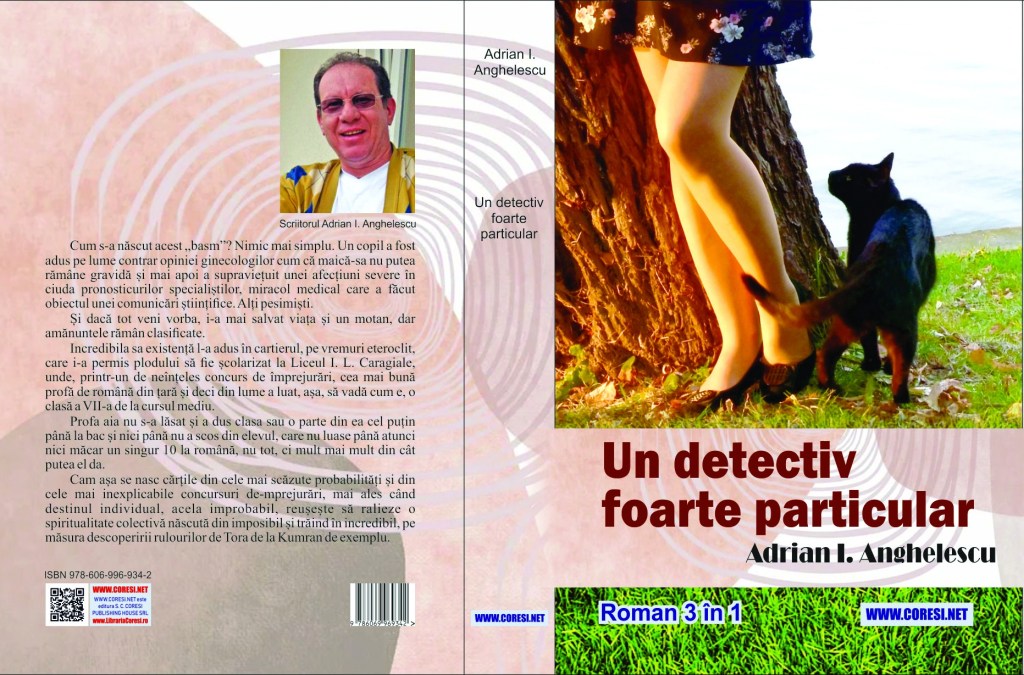
Click to buy Un Detectiv Foarte Particular, by Adrian Anghelescu, Romanian version, here:
Editura Coresi, Coresi Publishing House, Librăria Poiana Minunată, Librăria Constelații, Cărți pentru Diaspora.
Discover My World: Find My Books at Mihai Eminescu Bookstore in Bucharest or Order Directly from the Publisher, Vasile Lascăr Street, №5, Coresi! International Shipping Available!
19. What exactly would you like to convey to a fellow writer/an editor/screenwriter/film producer?
Where can your works be read in English?
A.A.: My books will soon be available in English.
Announcements and details will be posted on my Social Media Personal Profile: Facebook.
Open for collaboration with fellow writers/editors/screenwriters/film producers.
Reach out.
My writings are designed to be very succinct and at the same time multi-layered.
Those People presents a barely romanticized biography of the creator of blue jeans (living conditions in Bavaria and the conquest of the American West) in parallel with an imagined last burial in his native village in Franconia (northern Bavaria), providing an opportunity to present the situation in Germany in 1938.
The trilogy The Destiny of a Private Detective follows the police exploits of the protagonist, Sergiu Oren, although explaining the events would reveal too much.
Part One: A Movielike Lover or The Geometry of Concurrent Parallels is inspired by a random fact – the disappearance at sea of a French doctor with his wife and two children, which provides Sergiu with an opportunity to travel around Europe, including Sicily and the Vatican, and complete his erotic record, thanks to the very exciting diary left by the doctor’s wife. The ending is tough to predict, and I would even say painful.
Part Two: The Art of Kissing or Little Green Russia contains a police plot but is primarily a novel of anticipation, set in a state where an ecological dictatorship has been established, the world’s first “green” state (a typical exploitation of a correct ideology on paper towards a totalitarian regime).
Part Three: The Art of Being Perfect or Macabre Trinity and the Walls with Blood Shadows is a great thriller set against the backdrop of three murders committed in a monastery. Twists and space-time travels await the reader here, too.
20. Embers of Endings
Envision the conclusion of a significant project. How do you feel as you pen the final words or brush the last strokes? What is the emotional resonance of completion, and how does it influence your anticipation for the next artistic endeavor?
A.A.: On one hand, it represents the pinnacle of your efforts, providing a sense of achievement. On the other hand, it’s akin to a parent who, despite desiring their child’s independence and their own home, feels heartbroken over the impending separation.


 Julia Kalman
You must be logged in to post a comment.